Daily Habits that calm Anxiety Naturally
27th March, 2026 | By:Saashrika G
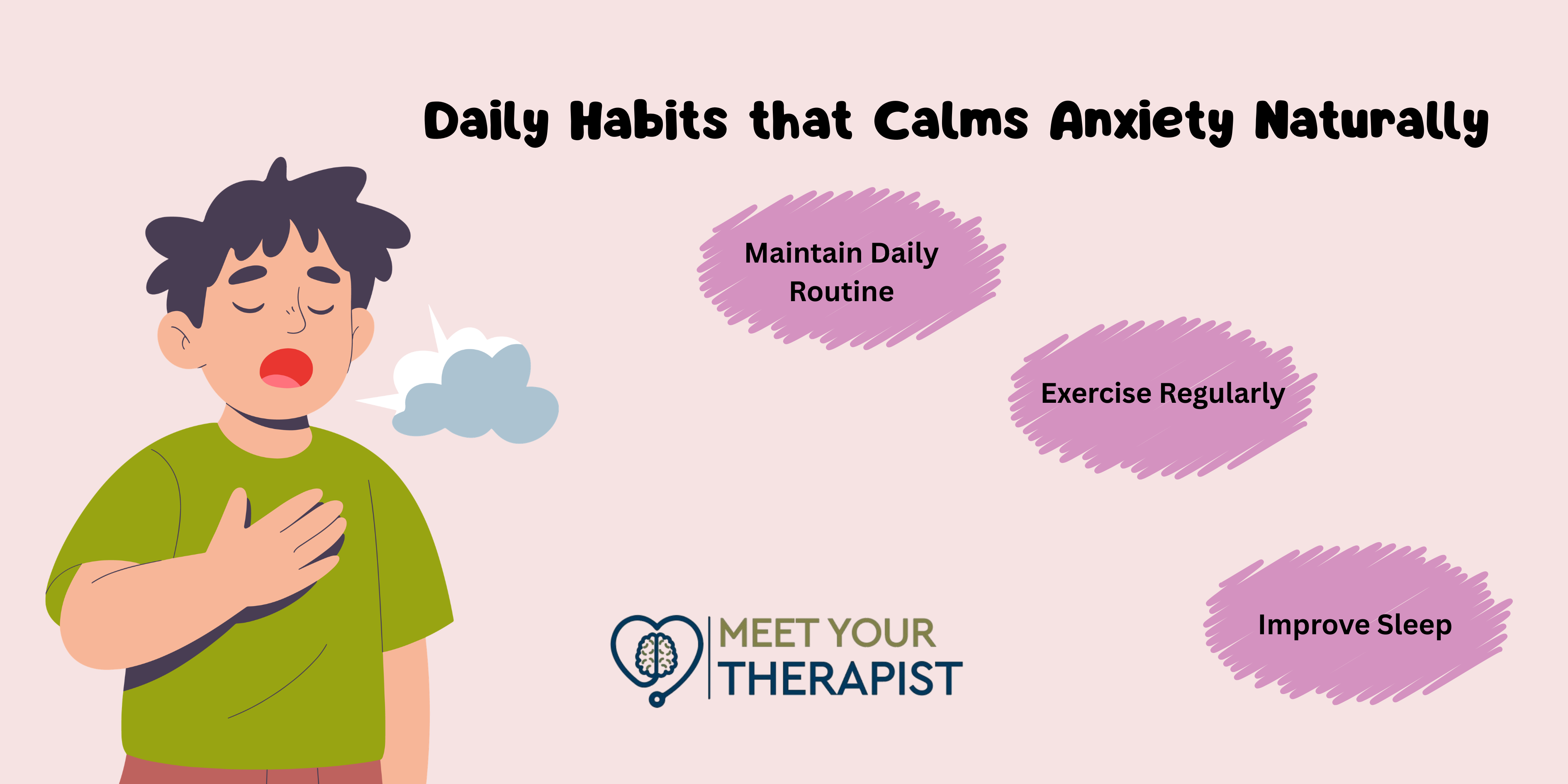
Anxiety is often associated with therapy or medication, but research shows that the way we live every day, how we sleep, eat, move, breathe, and structure our time, has a powerful impact on anxiety levels. In fact, studies in lifestyle psychiatry show that daily habits and lifestyle changes can significantly reduce anxiety symptoms and improve emotional regulation (Sarris et al., 2012; Firth et al., 2020). These habits work not by “eliminating stress,” but by regulating the nervous system.
For example, consistent sleep helps regulate the amygdala (the brain’s fear center), exercise reduces cortisol (the stress hormone) and increases endorphins, slow breathing activates the parasympathetic nervous system (the body’s calming system), and mindfulness practices improve emotional regulation by strengthening the prefrontal cortex the part of the brain responsible for decision-making and emotional control (Hoge et al., 2013; Scott et al., 2021).
Over time, these small daily habits increase emotional resilience, meaning a person may still experience stress, but they are better able to cope with it without becoming overwhelmed.You can think of anxiety like a sensitive alarm system, daily habits don’t remove the alarm, but they make it less reactive and easier to calm. This is why mental health professionals often combine therapy with lifestyle changes, because what we do every day shapes how our brain and body respond to stress (Firth et al., 2020).
1. Maintain a Daily Routine
Having a structured daily routine, including regular sleep, meals, work, and relaxation, can significantly help in reducing anxiety. One of the core features of anxiety is uncertainty and lack of control. Research shows that people with less structured daily routines report higher levels of anxiety and depressive symptoms, while consistent routines are associated with better psychological well-being, improved self-efficacy, and better emotional stability (Fiese et al., 2002; Sarris et al., 2012). During stressful situations, routines provide a sense of normalcy and stability, which helps people cope better with stress.
From a psychological perspective, routines reduce decision fatigue and mental overload. When your brain does not have to constantly decide when to sleep, eat, or work, it uses less mental energy, which reduces overwhelm and anxiety.
Simple Habits to Start
You don’t need a perfect routine. Start small and keep it realistic:
- Wake up at the same time every day
- Eat meals at roughly fixed times
- Have a fixed sleep time
- Schedule relaxation time
- Schedule a 10-minute “worry time” (instead of worrying all day)
This is where rumination comes in- a repetitive, often negative thinking that loops without resolution. Research consistently shows that rumination is closely tied to both anxiety and sleep disruption, creating a cycle where thinking more makes it harder to rest, and lack of rest makes the thinking worse (Slavish & Graham-Engeland, 2015).
Studies also show that rumination specifically increases cognitive and emotional activation, making it harder to fall asleep and easier to get stuck in anxious cycles.
2. Exercise Regularly
Exercise is one of the most researched and evidence-based natural ways to reduce anxiety. Many people think exercise is only for physical health, but research shows that it has a direct impact on brain chemistry, stress hormones, and emotional regulation.
A large scientific review found that physical activity significantly improves symptoms of anxiety and psychological distress across different populations, including students, working adults, and individuals with clinical anxiety (Singh et al., 2023). In some cases, regular exercise has been found to be as effective as medication for mild to moderate anxiety.Exercise helps reduce anxiety in several biological and psychological ways:
- It reduces cortisol (stress hormone)
- It releases endorphins (feel-good chemicals)
- It increases serotonin and dopamine (mood regulation)
- It improves sleep quality
- It reduces muscle tension, which is a physical symptom of anxiety
- It gives a sense of routine, control, and accomplishment
From a psychological perspective, exercise also helps because it moves the body out of the “fight or flight” state and into a more relaxed state.
You can think of exercise as a way of “burning off stress hormones” from the body.
Simple Habits to Start
You don’t need a gym. Anxiety reduces even with moderate movement:
- 30 minutes walking
- Yoga
- Stretching
- Dancing
- Cycling
- Any sport
- Even 10-minute movement is helpful
The goal is consistency, not intensity.
3. Improve Sleep
Sleep and anxiety are deeply connected. In fact, anxiety and poor sleep often create a cycle, anxiety makes it hard to sleep, and lack of sleep makes anxiety worse the next day. Research shows that sleep is not just rest; it is a time when the brain processes emotions, regulates stress hormones, and resets the nervous system.
A large meta-analysis found that improving sleep quality led to significant reductions in anxiety, depression, stress, and rumination, showing that sleep improvement alone can lead to better mental health outcomes (Scott et al., 2021). This means that sometimes, improving sleep is not just about feeling rested it is actually a part of treating anxiety.From a brain perspective, when you don’t sleep enough:
- The amygdala (fear center) becomes more reactive
- The prefrontal cortex (logical thinking) becomes less effective
- The body produces more cortisol (stress hormone)
This makes a person more emotionally reactive, more worried, and less able to cope with stress. This is why many psychologists say: “Sleep is not a luxury. It is emotional regulation.”
Simple Habits to Improve Sleep
Start with small changes:
- Sleep at the same time every day
- Wake up at the same time every day
- Avoid phone 30–60 minutes before bed
- Reduce caffeine in the evening
- Keep lights dim before sleep
- Do a calming activity before bed (reading, stretching, prayer, journaling)
4. Practice Mindfulness or Meditation
Mindfulness is one of the most evidence-based psychological techniques for managing anxiety. Anxiety usually involves worrying about the future or overthinking about the past, while mindfulness trains the mind to focus on the present moment. This shift alone can significantly reduce anxiety symptoms.
A randomized controlled trial found that mindfulness meditation significantly reduced anxiety symptoms in individuals with Generalized Anxiety Disorder, and also improved stress reactivity and emotional regulation (Hoge et al., 2013). Many therapy approaches today, such as Mindfulness-Based Stress Reduction (MBSR) and Mindfulness-Based Cognitive Therapy (MBCT), are built around this idea.
Mindfulness works by:
- Reducing overthinking and rumination
- Improving emotional regulation
- Increasing present-moment awareness
- Reducing emotional reactivity
- Strengthening the prefrontal cortex (decision-making and emotional control)
- Calming the amygdala (fear center)
In simple words, mindfulness teaches a person to observe their thoughts instead of getting carried away by them.“Mindfulness is not about stopping thoughts. It is about not letting thoughts control you.”
Simple Habits to Start
You don’t need long meditation hours. Start small:
- 5–10 minutes deep breathing
- Body scan meditation
- Mindful walking
- Mindful eating
- Sit quietly and observe your thoughts
- Notice 5 things you can see, 4 you can feel, 3 you can hear (grounding technique)
Consistency is more important than duration.
5. Practice Deep Breathing
Breathing techniques are one of the fastest ways to calm anxiety because they work directly on the nervous system, not just the mind. When a person is anxious, their breathing becomes fast, shallow, and irregular, which signals to the brain that there is danger. This activates the sympathetic nervous system (fight-or-flight response).
Slow, controlled breathing does the opposite — it activates the parasympathetic nervous system, which is the body’s natural calming system. This reduces heart rate, relaxes muscles, and signals safety to the brain.
Research shows that breathing interventions, especially when practiced regularly, significantly reduce stress, anxiety, and symptoms of emotional distress (Bentley et al., 2023). This means breathing is not just a relaxation trick it is a physiological treatment for anxiety.
“You cannot always control your thoughts, but you can control your breathing. And when you control your breathing, you send a message to your brain that you are safe.”
Simple Breathing Technique to Start
Try this basic breathing exercise:
- Inhale for 4 seconds
- Hold for 4 seconds
- Exhale for 6 seconds
- Repeat for 5 minutes
- Inhale for 4 seconds
- Hold for 4 seconds
- Exhale for 4 seconds
- Hold for 4 second
4–4–6 Breathing
Box breathing (4–4–4–4)
Reduce caffeine intake
Many people don’t realize caffeine can worsen anxiety
A 2024 meta-analysis found that caffeine consumption may increase anxiety and anxiety risk, especially at higher doses.
Simple habit
- Reduce coffee/energy drinks
- Switch to tea or decaf
References
1.Firth, J., Solmi, M., Wootton, R. E., et al. (2020). A meta-review of “lifestyle psychiatry”: The role of exercise, sleep, diet and mindfulness in mental health. World Psychiatry, 19(3), 360–380.
2. Hoge, E. A., et al. (2013). Randomized controlled trial of mindfulness meditation for generalized anxiety disorder. Journal of Clinical Psychiatry, 74(8), 786–792.
3. Scott, A. J., et al. (2021). Improving sleep quality leads to better mental health: A meta-analysis. Sleep Medicine Reviews, 60, 101556.