Living with Obsessive-Compulsive Disorder: More Than Just Cleanliness
23rd March, 2026 | By:Sagarika UK
“Everyone is a little OCD”
It’s usually said lightly. Sometimes even affectionately. As a way of saying someone likes things a certain way : organized, clean, particular. And if you’ve heard that while quietly struggling with something that feels nothing like that, it doesn't land well.
Because what you’re dealing with doesn’t feel like a preference.It feels like something you can’t quite step out of.
You may recognise that the thoughts don’t make sense. You may even know that they go against your values or intentions. But despite that awareness, they keep returning. Sometimes they feel intrusive, sometimes disturbing, and often difficult to let go of.
Alongside them, you might notice a growing need to check, reassure yourself, or mentally review what happened. For many people, this experience can feel confusing and isolating. It is easy to wonder whether something about your thinking is unusual, or whether these thoughts say something deeper about who you are.
Obsessive-Compulsive Disorder, or OCD, is often misunderstood as a preference for cleanliness or order. While it can sometimes include these patterns, the core experience is usually very different. OCD involves a particular relationship with thoughts, where certain ideas feel significant, urgent, and difficult to dismiss. Understanding how this process works is often the first step in making sense of the experience and reducing the self-doubt that comes with it.
OCD Is Not Just About Cleanliness
Many people grow up with a simplified idea of OCD, where it is associated with being organised, particular, or overly neat. In reality, OCD is less about the content of behaviour and more about how the mind responds to uncertainty.
A thought appears, often suddenly and without intention. For most people, thoughts come and go without much attention. In OCD, however, certain thoughts tend to hold attention for longer. The mind begins to engage with them, asking questions, trying to understand why they appeared, or what they might mean.
This shift is subtle, but important. The thought is no longer just something that happened. It becomes something that needs to be resolved. Over time, this can create a pattern where the mind repeatedly returns to the same question, not because it is meaningful, but because it feels unresolved.
How OCD Shows Up in Everyday Experience
The way OCD appears can vary widely, and many forms are not immediately visible to others. What often changes is not just what you think, but how much weight the thought begins to carry.
For some people, this takes the form of Harm OCD. You might notice a sudden concern about whether you could unintentionally hurt someone, even when there is no intention to do so. These thoughts tend to feel especially distressing because they are so inconsistent with your values. In response, you may find yourself monitoring your actions more closely, avoiding certain situations, or repeatedly reassuring yourself that you would never act on such thoughts. Even when the anxiety reduces briefly, the doubt tends to return.
For others, the experience may align more with Sexual or Intrusive Thought OCD. These thoughts can feel inappropriate, taboo, or completely out of character. What makes them difficult is not only their content, but the meaning that gets attached to them over time. Instead of remaining just a thought, they begin to raise questions about identity or intention. It is often here that people start to experience a deeper layer of discomfort and not just anxiety, but also guilt or shame, making it harder to step back from the thought itself.
In some cases, OCD takes a more moral or spiritual direction, often referred to as Scrupulosity (Religious or Moral OCD). You may find yourself repeatedly questioning whether something you did was right or wrong, whether you followed a rule correctly, or whether you have unintentionally made a mistake. This can lead to repeated checking, reviewing, or attempts to feel morally certain. However, the sense of certainty is usually short-lived, leading the process to repeat.
With Checking or Reassurance-Seeking OCD, this might involve going over the same action multiple times ; checking locks, re-reading messages, or asking others for confirmation. Even when you receive reassurance, the doubt may not fully settle. Sometimes, people around you may try to help by providing repeated reassurance, but this can unintentionally make the pattern more persistent over time.
With others, the process remains mostly internal, often described as “Pure O” (Primarily Obsessional OCD). Here, the compulsions are less visible and take the form of mental reviewing, analysing, or trying to neutralise thoughts. From the outside, it may not appear that anything is happening, but internally, the experience can feel continuous and effortful, as the mind tries to arrive at a place of certainty.
Understanding the Pattern
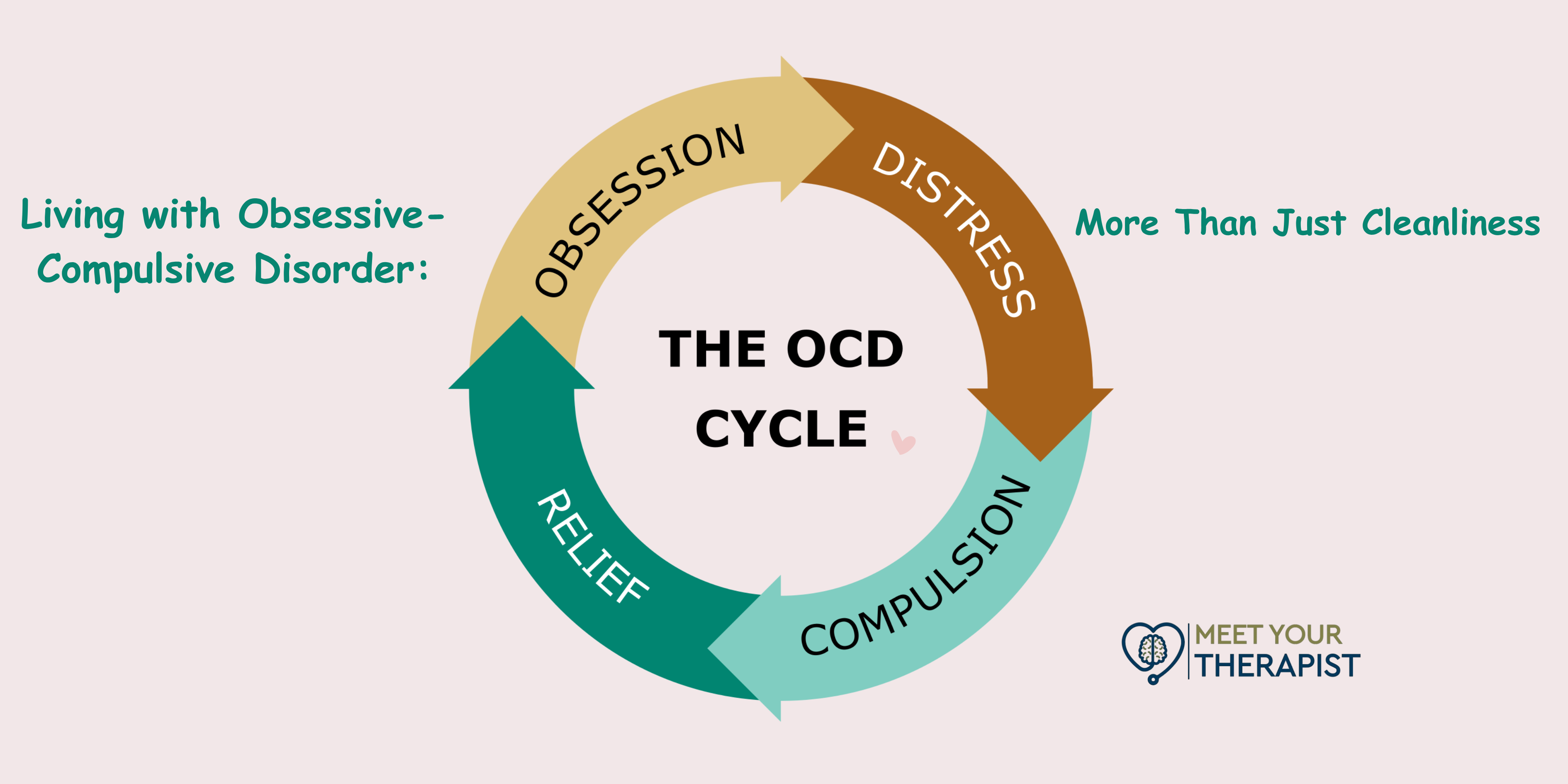
OCD often follows a repeating cycle. An intrusive thought appears, leading to discomfort or anxiety. In response, a behaviour or mental action is performed to reduce that discomfort. This may provide temporary relief, but it also reinforces the need to respond in the same way the next time the thought appears.
Obsession - Distress - Compulsion - Relief - Reinforcement
Over time, this pattern can become more frequent, not because the thoughts are becoming more meaningful, but because the mind has learned that responding to them provides short-term relief. As a result, the thoughts tend to return more often, and the need to respond to them can feel stronger.
Why It Feels Difficult to Let Go
Because OCD is maintained by the cycle of thoughts and responses, treatment often focuses on gradually changing this pattern. One of the most widely used approaches is Exposure and Response Prevention (ERP).
ERP involves gently facing the thought or situation that triggers discomfort, while reducing the usual response that follows. Instead of immediately checking, avoiding, or seeking reassurance, the individual learns to stay with the uncertainty for a period of time. Over time, this helps the mind learn that the discomfort can reduce on its own, without needing a specific action to resolve it.
This process is usually gradual and structured, and is done with guidance so that it feels manageable. As the cycle begins to shift, many people notice that thoughts become less intrusive and easier to disengage from.
A Final Note
If you have been experiencing patterns like these, it can sometimes be difficult to talk about them openly, especially when the thoughts feel confusing or out of character. Many people initially assume they should be able to manage it on their own, or that the thoughts will pass if ignored.
However, when these patterns persist, they often benefit from a more structured understanding. OCD is not a reflection of who you are, but rather a pattern in how the mind responds to certain thoughts and uncertainties.
With the right support, this pattern can change. If you would like to explore these experiences in a supportive and confidential setting, professional help can provide a clearer understanding of what you are going through. Therapy offers a space to work through intrusive thoughts, reduce compulsive patterns, and build a different relationship with uncertainty
You can seek support through Meet Your Therapist, where trained clinicians work with individuals experiencing OCD and related concerns.