Why Does Anxiety Get Worse at Night?
24th March, 2026 | By:Veola Noronha
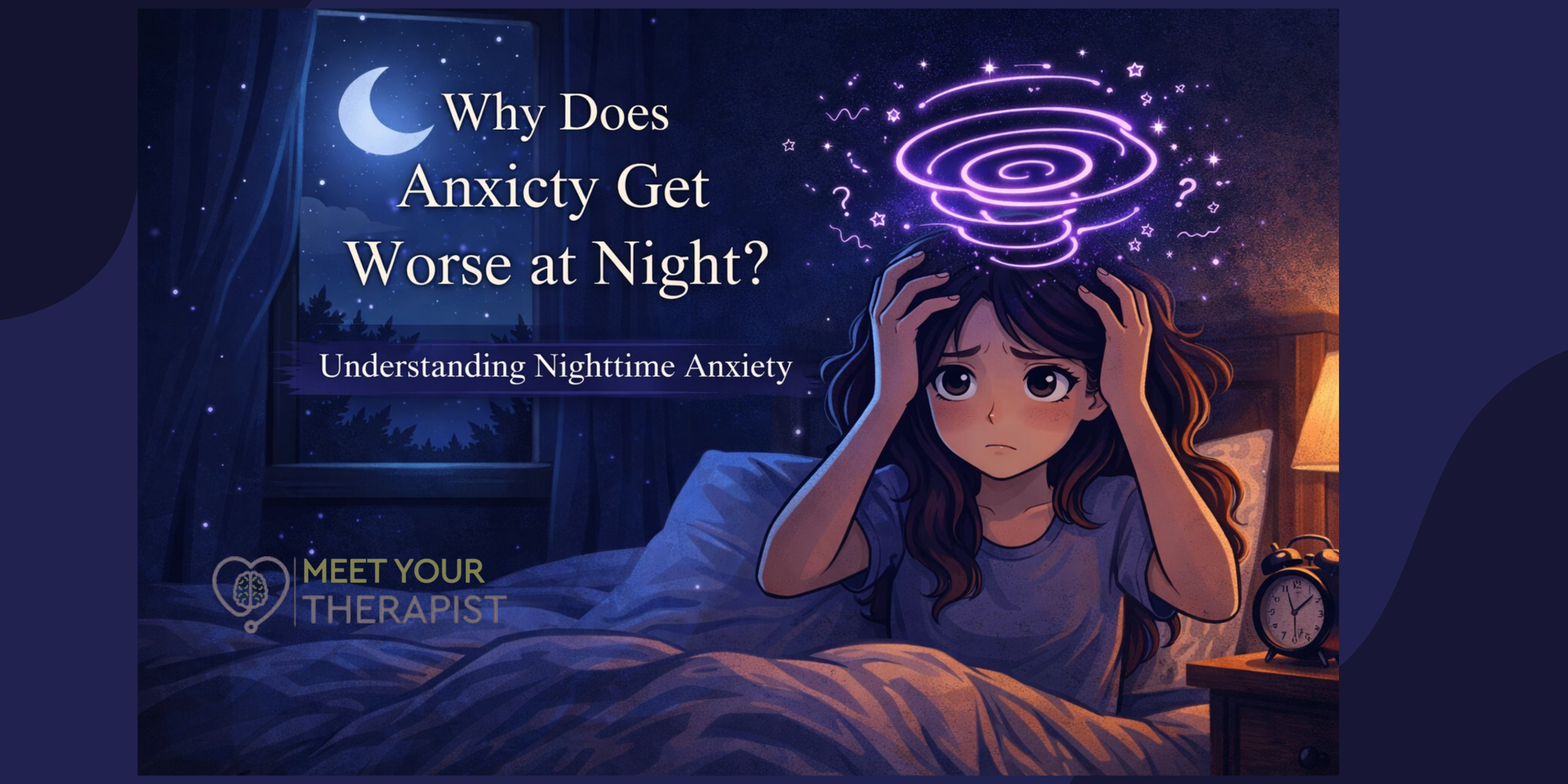
"Let me not sleep tonight. Let all my organs, mind and soul be awake. At night silence is so noisy to tremble my being. Holding breath for some time to calm down the palpitation of my heart. In day light among the crowd I forget who I am. I am more sensitive to lose my temperament alone at night. Night is the time when I feel more sensation in my body. Silence is my friend or foe difficult to comprehend. Silence keeps creating sound like the thunder storm. " - Riaz Laskar
There’s something about nighttime that makes everything louder.
Not literally- the world is quieter, if anything. Fewer notifications, fewer conversations, fewer demands pulling at your attention. But somehow, that silence feels loud.
Thoughts you brushed aside at 2pm come back sharper at 2am. A small worry stretches into a full-blown spiral. Things that felt manageable in daylight suddenly feel unsolvable in the dark.
If you’ve ever found yourself lying in bed, exhausted but wired, replaying conversations, anticipating worst-case scenarios, or questioning your entire life, you’re not alone.
This article explores why anxiety tends to intensify at night- from the way our brains process stress to what happens when the world finally goes quiet- and what that means for how we understand ourselves.
When the Noise Stops, Your Brain Gets Louder
During the day, your mind is busy surviving the day-to-day. There are things to do, people to respond to, places to be. Even when anxiety is present, it often gets channeled into activity- overthinking turns into productivity, worry turns into planning, restlessness turns into movement.
But at night, all of that scaffolding disappears.You’re left alone with your thoughts; and your brain, suddenly unoccupied, does what it’s always been trying to do: process everything you didn’t have time to feel during the day.
This is where rumination comes in- a repetitive, often negative thinking that loops without resolution. Research consistently shows that rumination is closely tied to both anxiety and sleep disruption, creating a cycle where thinking more makes it harder to rest, and lack of rest makes the thinking worse (Slavish & Graham-Engeland, 2015).
Studies also show that rumination specifically increases cognitive and emotional activation, making it harder to fall asleep and easier to get stuck in anxious cycles.

Your Body Wants Sleep. Your Brain Wants Answers.
Nighttime anxiety isn’t just psychological. It’s also biological.
As your body prepares for sleep, it begins to slow down. But your brain doesn’t always follow that same timeline. In fact, the conditions for sleep can unintentionally make anxious thinking worse.
One way researchers understand this is through something called cognitive hyperarousal- a state of heightened mental and physiological activation that makes it difficult to fully “switch off.” While this is often studied in the context of insomnia, the same pattern can show up more generally: even when you’re tired, your mind stays active, your body doesn’t fully settle, and thoughts become harder to quiet.
Another piece of the puzzle is how stress is processed. When you’re awake and busy, your brain can delay emotional processing. But when you finally lie down, those unresolved thoughts resurface, not because you’re doing something wrong, but because your brain is trying to complete unfinished loops.
Studies also show that rumination specifically increases cognitive and emotional activation, making it harder to fall asleep and easier to get stuck in anxious cycles.
The 3AM Version of You Is Not Reliable
There’s a reason everything feels worse at night. It’s not just the thoughts themselves, but your ability to cope with them.
By the end of the day, your mental resources are depleted. Decision fatigue sets in. Emotional regulation becomes harder. The same thought that felt manageable in the morning can feel overwhelming at night simply because you’re too tired to process it effectively.
Research on sleep and cognition shows that poor sleep and sustained wakefulness impair emotional regulation and increase vulnerability to stress and anxiety-related thinking (Palmer & Alfano, 2017).
In other words, your brain at night is not operating at full capacity, but it’s still trying to solve full-sized problems.
That’s how you end up believing things like:
- “This will never work out.”
- “I’ve messed everything up.”
- “I need to figure my entire life out right now.”
Not because they’re true, but because your brain is exhausted and trying to create certainty in the absence of clarity.The 3AM version of you isn’t more insightful.It’s just more overwhelmed.
Anxiety and Sleep: A Loop, Not a Line
One of the most frustrating parts of nighttime anxiety is how quickly it turns into a cycle.
- You feel anxious → you can’t sleep
- You can’t sleep → your brain has more time to think
- You think more → your anxiety increases
And the loop continues.
Research supports this bidirectional relationship: rumination and worry at bedtime are associated with worse sleep quality, and poor sleep in turn amplifies emotional distress the next day (Palmer & Alfano, 2017).
Over time, this can create a pattern where nighttime itself becomes a trigger.
So What Now?
Nighttime anxiety doesn’t mean you’re “too sensitive” or “overthinking everything.”
It means your brain is trying to process things that matter.But not every thought needs to be solved at midnight.
Some ways to navigate it:
- Name what’s happening:“This is rumination, not problem-solving.” That distinction matters.
- Delay the spiral.Don’t suppress, but delay. Tell yourself you’ll revisit it tomorrow when your brain is better equipped.
- Externalise the thoughts.Write them down. Get them out of your head and somewhere visible.
- Be suspicious of late-night conclusions.If it feels urgent at 2 AM, it probably isn’t accurate.
You don’t need to silence your mind completely.
You just need to stop treating every thought like it’s true.
Conclusion
Nighttime anxiety isn’t a personal failure. It’s what happens when a busy brain finally has space to slow down but doesn’t quite know how. In the quiet, thoughts and worries surface more easily and can feel bigger than they are, especially when you’re tired. But feelings at night aren’t always reliable; they’re shaped by fatigue and an overloaded mind. You don’t have to solve everything in the dark.
Sometimes, just getting through the night is enough, and things often feel more manageable in the morning.
References
1. Slavish DC, Graham-Engeland JE. Rumination mediates the relationships between depressed mood and both sleep quality and self-reported health in young adults. J Behav Med. 2015 Apr;38(2):204-13. doi: 10.1007/s10865-014-9595-0. Epub 2014 Sep 7. PMID: 25195078; PMCID: PMC4362854.
2. Palmer CA, Alfano CA. Sleep and emotion regulation: An organizing, integrative review. Sleep Med Rev. 2017 Feb;31:6-16. doi: 10.1016/j.smrv.2015.12.006. Epub 2016 Jan 14. PMID: 26899742.