61.Healing vs Hustle Culture: Why Rest Feels So Uncomfortable
24th April, 2026 | By: Saashrika G
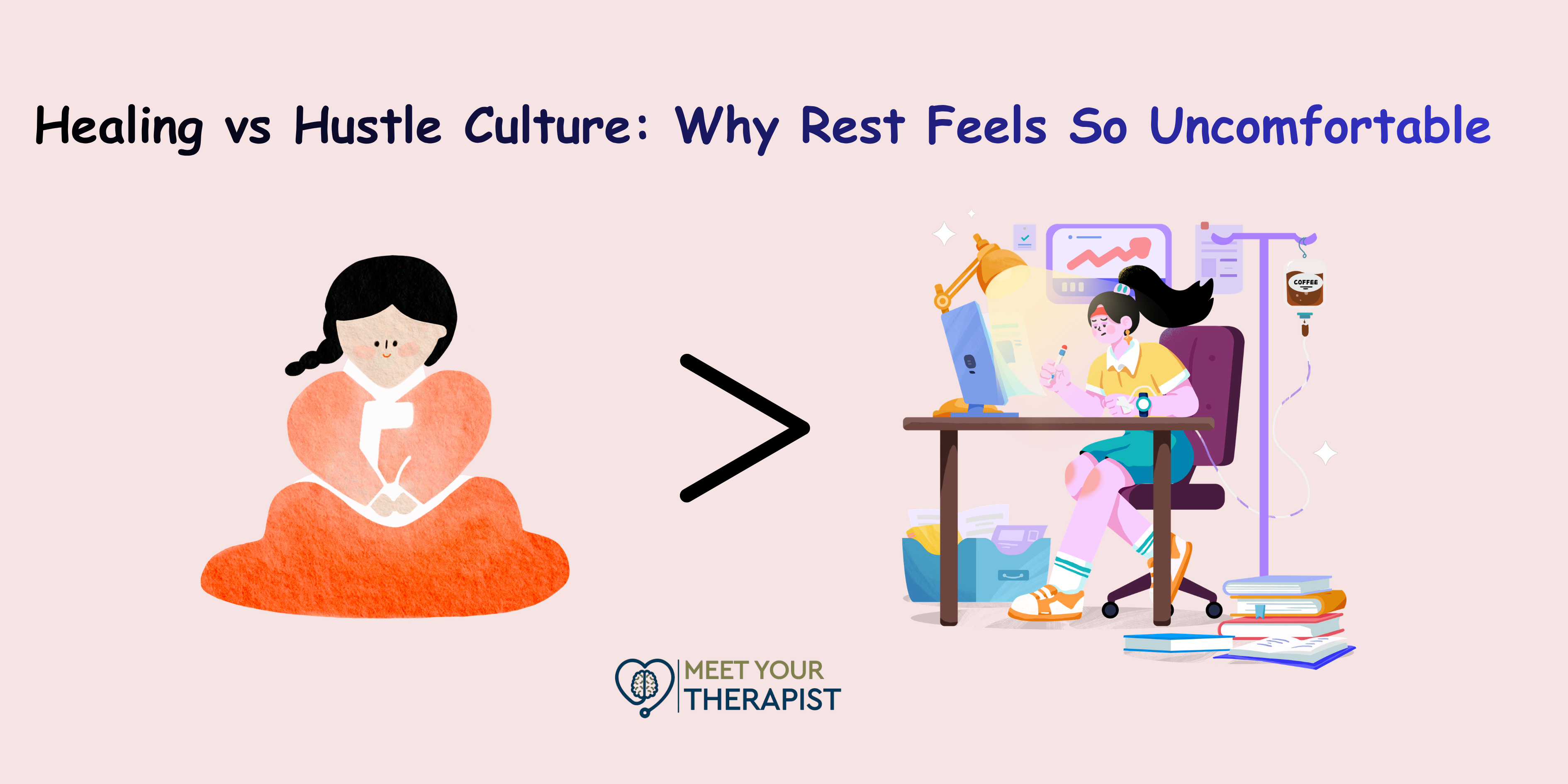
We live in a world that rewards constant motion. Productivity is praised, busyness is glorified, and rest is often treated like something you have to earn. Somewhere between chasing goals and meeting expectations, many of us have internalized a quiet belief: if I’m not doing something, I’m falling behind.
Pause for a moment and ask yourself:
- When was the last time you rested without feeling guilty?
- Do you ever reach the end of the day and feel like you still haven’t done “enough”?
- Have you ever turned a moment of rest into productivity, scrolling, planning, optimizing?
If your answer is yes, you’re not alone. Psychologically, this discomfort isn’t random, it’s learned.
According to research on self-worth and achievement, many individuals develop what is called contingent self-worth, where their value depends on productivity, success, or external validation (Crocker & Wolfe, 2001). Over time, this creates a cycle: the more you do, the more worthy you feel, but the moment you stop, that sense of worth feels threatened.
At the same time, modern environments reinforce this loop. Social comparison plays a powerful role, constantly seeing others achieve, post, and “move forward” can intensify the fear of falling behind (Festinger, 1954). Even rest begins to feel like a risk
So when we finally pause, when we try to rest, slow down, or heal, it doesn’t always feel peaceful. It feels… uncomfortable.
Why?
Because rest removes the distraction
When you’re constantly busy, your mind is occupied. But in stillness, thoughts surface. Emotions you’ve postponed, stress, fatigue, self-doubt, begin to come into awareness. From a psychological perspective, this aligns with research on experiential avoidance, where individuals use activity or distraction to avoid uncomfortable internal experiences (Hayes et al., 1996).
This blog explores the psychological reasons why teenagers stop talking to their parents and what parents can do to rebuild communication.
From a nervous system perspective, if you’ve been operating in a prolonged state of activation (stress, deadlines, constant engagement), slowing down can feel dysregulating. Your system has adapted to “go mode,” so stillness doesn’t immediately register as rest, it registers as discomfort (Porges, 2007).
Try noticing this the next time you rest:
- Do you feel the urge to check your phone?
- Does your mind start racing with tasks?
- Do you feel slightly restless, even when you want to relax?
That’s not failure. That’s your system adjusting. In a culture that equates doing with being, rest can feel like losing a part of your identity. But in reality, it may be the beginning of reconnecting with it.
Why Rest Can Feel So Hard
Rest isn’t just physical, it’s psychological. When you stop “doing,” you’re left alone with your thoughts. And for many people, that’s where the discomfort begins.
Take a moment to check in with yourself:
- What happens when you sit in silence with no distractions?
- Do your thoughts slow down, or get louder?
- Do you feel relaxed… or slightly uneasy?
For many of us, rest doesn’t feel like relief, it feels like exposure.
Because when the noise of constant activity fades, what often surfaces are the things we’ve been unintentionally avoiding:
- Unprocessed stress
- Emotional fatigue
- Self-doubt
- Existential questioning
From a psychological perspective, this connects to experiential avoidance, our tendency to stay busy, distracted, or productive to avoid uncomfortable internal experiences (Hayes et al., 1996). Hustle, in this sense, isn’t always about ambition. Sometimes, it’s about escape. You might not even realize it’s happening.
Filling your schedule, overworking, constantly checking your phone, or jumping from one task to another can act as subtle ways of not sitting still long enough to feel what’s underneath.
So when you finally rest, it’s not just rest, you’re also meeting everything that’s been waiting. There’s also a cognitive layer to this discomfort.
Research on mind-wandering shows that when the brain is not engaged in a task, it naturally drifts inward, often toward unresolved concerns or worries (Killingsworth & Gilbert, 2010). This means that stillness can amplify awareness of dissatisfaction or emotional strain, making rest feel mentally taxing rather than soothing.
And then there’s the nervous system. If you’ve been functioning in a prolonged state of stress or high alert, constantly “on,” constantly responding, your system adapts to that pace.
Slowing down can feel unfamiliar, even unsettling. According to the polyvagal theory, safety isn’t just about the absence of danger, it’s about what your body is used to (Porges, 2007).So if your body is used to busyness, stillness might initially feel like discomfort, not calm. This is why rest can feel so hard. Not because you’re doing it wrong, but because rest is not just stopping activity. It’s making space. And in that space, you begin to encounter yourself, your thoughts, your emotions, your inner world, without distraction. Hustle can keep you moving. But healing asks you to stay.
Healing Requires a Different Pace
Healing doesn’t follow deadlines. It doesn’t reward urgency. It asks for slowness, patience, and presence, things that directly contradict hustle culture.
Pause and reflect:
- Have you ever tried to “fix” yourself quickly?
- Felt frustrated that you’re not “over it” yet?
- Treated healing like a checklist instead of a process?
That urge to rush healing often comes from the same system that values productivity, where progress is expected to be visible, measurable, and fast.
But psychologically, healing operates differently.
Research on emotional processing suggests that meaningful change requires time and repeated engagement with internal experiences, not avoidance or suppression (Greenberg, 2002). You don’t heal by pushing emotions away, you heal by allowing, understanding, and integrating them.
This is why healing asks you to:
- Pause instead of push → because constant action can override awareness
- Reflect instead of react → because insight creates change
- Feel instead of avoid → because unprocessed emotions don’t disappear, they persist And yes, this shift can feel deeply uncomfortable.
Because it challenges a core belief- that faster is better. Healing gently disrupts that belief and replaces it with something less familiar—but more sustainable: slower can be deeper.
Rest Is Not the Opposite of Growth
One of the biggest misconceptions is that rest equals stagnation.
But let’s question that:
- Do you think more clearly when you’re exhausted or well-rested?
- Are you more creative when you’re burnt out or when your mind has space?
- Do you make better decisions when you’re overwhelmed or regulated?
Rest is not the absence of growth, it’s what makes growth possible. From a neuroscience perspective, rest plays a key role in memory consolidation and cognitive integration, allowing the brain to process and organize information (Walker & Stickgold, 2004). Emotionally, rest supports regulation, helping you respond rather than react.
In other words, rest is not “doing nothing.” It’s internal work that isn’t immediately visible. Rest allows:
- Emotional regulation
- Cognitive clarity
- Creative renewal
- Nervous system balance
- Without it, the system overloads.
And that’s where burnout emerges, not as a failure of effort, but as a consequence of chronic overextension without recovery (Maslach & Leiter, 2016).
Redefining Productivity
What if productivity didn’t just mean output?
Take a moment:
- Do you measure your day by how much you did or how you felt?
- Do you only feel accomplished when something is visibly completed?
Hustle culture defines productivity in terms of results. But psychological well-being requires a broader definition
Self-Determination Theory suggests that well-being comes from meeting basic psychological needs, autonomy, competence, and relatedness—not just constant achievement (Deci & Ryan, 2000).
So what if productivity also included:
- Taking care of your mental health
- Setting boundaries
- Allowing yourself to pause
- Choosing sustainability over speed
These may not look productive externally, but internally, they support long-term functioning, resilience, and well-being.
Healing is productive. It’s just not always visible, measurable, or immediate. Learning to Sit with Rest
If rest feels uncomfortable, that doesn’t mean you’re doing it wrong, it means you’re not used to it yet.
Instead of forcing yourself into perfect stillness, try approaching rest with curiosity:
- What comes up when I slow down?
- Can I observe this discomfort without trying to fix it immediately?
Practices like mindfulness emphasize non-judgmental awareness, simply noticing thoughts and emotions without reacting to them (Kabat-Zinn, 2003). Over time, this reduces reactivity and increases tolerance for stillness.
Start small:
- Take intentional pauses without distractions
- Notice the discomfort without judging it
- Remind yourself that slowing down is not failure
- Create gentle routines that include rest
Think of it less as “switching off” and more as building a new relationship with stillness. Gradually, your mind and body begin to recognize rest not as a threat, but as safety.
The Balance Between Healing and Hustle
This isn’t about rejecting ambition. It’s about balance.
You don’t have to choose between being driven and being well.
Ask yourself:
- Can I pursue goals without abandoning myself in the process?
- Can I rest before I burn out, not after?
Sustainable growth comes from cycles, effort and recovery, action and reflection.
The goal isn’t to stop striving.
It’s to stop tying your worth only to striving.
Because you are more than what you produce.
Closing Thought
In a culture that constantly tells you to do more, choosing to rest can feel like resistance. But maybe rest isn’t a weakness to overcome, maybe it’s a strength we’re learning to reclaim. And maybe healing isn’t about becoming more productive, but about becoming more present.
References
Crocker, J., & Wolfe, C. T. (2001). Contingencies of self-worth. Psychological Review, 108(3), 593–623. https://doi.org/10.1037/0033-295X.108.3.593
Deci, E. L., & Ryan, R. M. (2000). The “what” and “why” of goal pursuits: Human needs and the self-determination of behavior. Psychological Inquiry, 11(4), 227–268. https://doi.org/10.1207/S15327965PLI1104_01
Festinger, L. (1954). A theory of social comparison processes. Human Relations, 7(2), 117–140. https://doi.org/10.1177/001872675400700202
Greenberg, L. S. (2002). Emotion-focused therapy: Coaching clients to work through their feelings. American Psychological Association.
Hayes, S. C., Wilson, K. G., Gifford, E. V., Follette, V. M., & Strosahl, K. (1996). Experiential avoidance and behavioral disorders: A functional dimensional approach to diagnosis and treatment. Journal of Consulting and Clinical Psychology, 64(6), 1152–1168. https://doi.org/10.1037/0022-006X.64.6.1152
Kabat-Zinn, J. (2003). Mindfulness-based interventions in context: Past, present, and future. Clinical Psychology: Science and Practice, 10(2), 144–156. https://doi.org/10.1093/clipsy.bpg016
Killingsworth, M. A., & Gilbert, D. T. (2010). A wandering mind is an unhappy mind. Science, 330(6006), 932. https://doi.org/10.1126/science.1192439
Maslach, C., & Leiter, M. P. (2016). Understanding the burnout experience: Recent research and its implications for psychiatry. World Psychiatry, 15(2), 103–111. https://doi.org/10.1002/wps.20311
Porges, S. W. (2007). The polyvagal perspective. Biological Psychology, 74(2), 116–143. https://doi.org/10.1016/j.biopsycho.2006.06.009
Walker, M. P., & Stickgold, R. (2004). Sleep-dependent learning and memory consolidation. Neuron, 44(1), 121–133. https://doi.org/10.1016/j.neuron.2004.08.031